
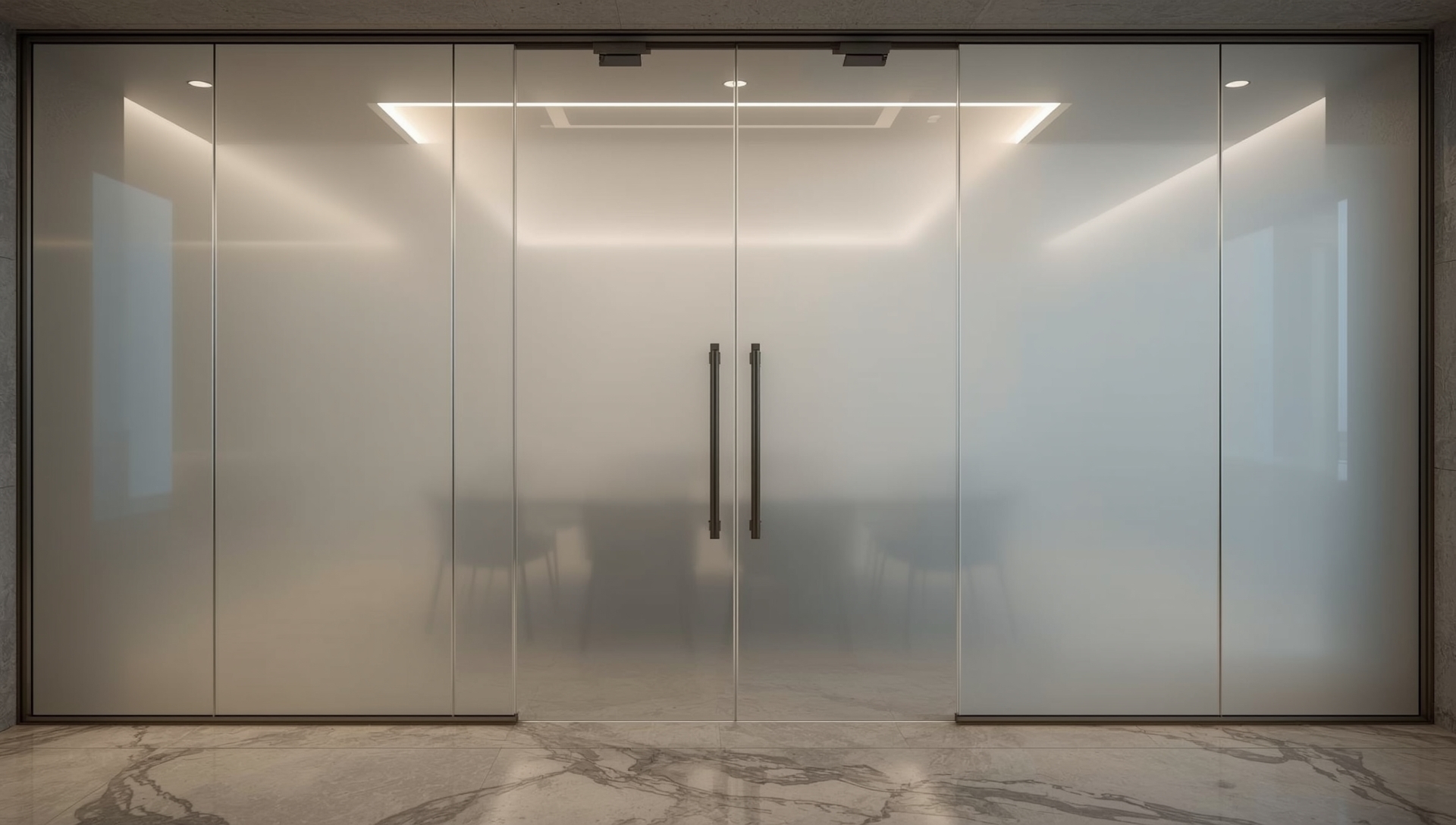
The conference room is often the most scrutinized space in any office. It is where deals close, strategies are presented, personnel decisions are made, and the company's brand is put on display for clients, investors, and prospective hires. Every detail of that environment sends a message. The quality of the furniture, the clarity of the display screens, the cleanliness of the surfaces, and yes, the privacy solutions on the glass walls all communicate something about the organization that occupies the space.
For decades, the default answer to conference room privacy was blinds. Horizontal slat blinds, vertical blinds, roller shades, or fabric curtains were installed on glass partitions and windows as a matter of course. The logic was simple: they are inexpensive, they are familiar, and they work well enough. But "well enough" has become a lower standard than modern Miami businesses are willing to accept, particularly for the spaces that matter most.
Switchable smart privacy film, powered by PDLC technology, is now the preferred choice for conference rooms in offices across Brickell, Coral Gables, Doral, and the wider South Florida region. The reasons go well beyond aesthetics. When you compare switchable film to traditional blinds across every meaningful dimension, including performance, maintenance, integration capability, and long-term cost, the case for film is clear and compelling.
This article breaks down that comparison in full, so you can make an informed decision about the right privacy solution for your conference room and the rest of your commercial space.
The Problem With Traditional Blinds
Traditional window blinds and shades have been a fixture of office interiors for generations. That familiarity has its own inertia. Facilities managers and office designers often specify them without much deliberation, simply because they have always been specified. But a closer look at how blinds actually perform in a busy commercial conference room reveals a long list of problems that add up to significant cost, frustration, and brand damage over time.
Dust and Allergen Accumulation
Horizontal blinds are among the most effective dust-collecting surfaces in any interior. Each individual slat traps particulate matter, and in Miami's humid subtropical climate, that dust combines with moisture to create grimy buildup that is visible to anyone seated near the windows. Regular cleaning requires taking the blinds down entirely or running a specialized duster across every slat. In a busy office environment, this maintenance is rarely performed as often as it should be, and the visible accumulation of dust on conference room blinds is a poor reflection on an organization's attention to cleanliness.
Mechanical Failure and Breakage
Blinds have moving parts, and moving parts break. The pull cord mechanisms that raise and lower horizontal blinds fail with regularity. Individual slats crack, bend, and warp over time. Vertical blind vanes come unclipped from their carriers and hang at awkward angles. Roller shade mechanisms jam or lose tension. In a conference room that sees multiple uses per day, these failures happen faster than facilities teams anticipate, and replacing damaged blinds interrupts the professional presentation of the space during the repair window.
Noise and Distraction
Blinds rattle. In any office building that experiences vibrations from HVAC equipment, foot traffic, or external sources, slat blinds produce a persistent low-level rattling that is particularly noticeable in the relative quiet of a conference room. Vertical blinds are especially prone to this, swaying and clattering against one another when doors open or air circulates. During video calls and presentations, that background noise is picked up by microphones and undermines the professional quality of the call.
Aesthetic Limitations
No matter how high the quality of the blinds specified, they carry an inherent aesthetic limitation. They segment the glass surface into horizontal or vertical bands, interrupt the visual flow of the space, and introduce a dated, residential quality to what should be a polished, contemporary professional environment. When the blinds are closed, the conference room interior loses its connection to the surrounding office and feels closed off rather than purposefully private. The visual impression on clients and visitors falls well short of what a premium workplace should convey.
How Switchable Privacy Film Solves Every Limitation
Smart privacy film addresses each of the limitations outlined above, not through compromise or partial improvement, but through fundamental elimination. The technology works differently enough from blinds that the comparison is almost categorical. Where blinds introduce complexity and maintenance burden, switchable film removes them. Where blinds degrade with use, film maintains its performance. Where blinds create visual noise, film delivers clean, intentional surfaces.
No Moving Parts, No Mechanical Failure
PDLC switchable film contains no mechanical components of any kind. There are no slats to crack, no cords to fray, no carriers to break, and no rollers to jam. The film responds to an electrical signal, and that electrical control system is the only component that requires any attention over the life of the installation. Quality smart film from reputable manufacturers is rated for tens of thousands of switching cycles. In practical terms, this means a conference room that switches its film between transparent and opaque multiple times per day, every day, can expect years of reliable performance without any physical maintenance on the film itself.
Effortless Cleanliness
Switchable film presents a flat, smooth glass surface that can be wiped clean with standard glass cleaner in seconds. There are no slats, no fabric panels, and no textured surfaces to trap dust. In Miami's climate, where humidity and air conditioning create conditions that accelerate dust accumulation and mold growth on fabric window treatments, this difference is meaningful. The film surface stays clean between regular office cleanings without requiring any special attention, and there is no buildup visible to clients or visitors at any point during the business day.
Instant, Silent Privacy Switching
When privacy is needed in a conference room fitted with switchable film, there is no pulling of cords, no adjusting of slats, and no fumbling with shade mechanisms. A single button press or switch toggle transitions the glass from fully transparent to completely opaque in under a second. The transition is silent, visually clean, and complete. There is no partial privacy state where gaps in blinds leave sightlines into the room, and there is no adjustment needed to get the right level of coverage. The film either allows full light transmission or blocks it entirely, with no in-between ambiguity.
Aesthetic Comparison: A Modern Upgrade
The visual impact of replacing conference room blinds with switchable privacy film is significant, and it is immediately apparent to anyone who enters the space. When the film is in its transparent state, the glass looks exactly like standard clear glazing. The conference room maintains its openness, its connection to the surrounding office environment, and the premium, light-filled character that modern workplace design prioritizes. There is nothing on the glass surface to catch the eye or interrupt the clean architectural lines of the room.
When privacy is required and the film switches to opaque, the glass takes on a uniform, smooth, milky-white appearance. This is not the visual equivalent of pulling down a shade or drawing a curtain. The opaque state of the film looks intentional and refined. It reads as a designed feature of the space, not a reactive cover-up measure. The difference in impression between an opaque privacy film surface and a closed set of horizontal blinds is substantial, and clients who have experienced both consistently describe the film solution as more sophisticated and more appropriate for a professional setting.
For Miami's design-conscious business community, this distinction matters. South Florida's commercial interiors have become increasingly sophisticated over the past decade, driven by an influx of firms with high standards for workplace aesthetics. Law firms on Brickell Avenue, financial services companies in Coconut Grove, and creative agencies in the Design District all operate in spaces where visual quality is part of the brand. A conference room with switchable film signals that the organization invests in quality at every level of the physical environment.
Durability, Maintenance, and Cost Over Time
The upfront cost of switchable privacy film is higher than the cost of standard window blinds. This is the primary objection most facilities managers raise when the technology is first proposed. It is a legitimate comparison point, but it becomes less meaningful when viewed over the realistic service life of both solutions and when all associated costs are accounted for.
Replacement Frequency
In a high-traffic conference room, low-cost horizontal blinds may require partial or full replacement within two to three years. Cord mechanisms fail. Slats break. Vertical blind vanes are lost or damaged during normal use. Even mid-range blinds in a busy commercial setting rarely last more than five years without visible degradation. Each replacement cycle adds procurement cost, installation cost, and downtime. Quality switchable film, by contrast, has a service life measured in ten years or more with minimal intervention. The higher initial investment is amortized across a much longer period.
Maintenance Labor
Blinds require regular manual cleaning that switchable film does not. In a commercial setting, that cleaning is either performed by in-house facilities staff, whose time has a cost, or by commercial cleaning contractors who charge for the additional labor. Over a multi-year period, the accumulated maintenance labor cost for a large conference room with multiple blind installations adds up to a real budget line item. The film, by contrast, requires nothing beyond the routine glass cleaning already included in any standard commercial cleaning contract.
Operational Consistency
There is also a softer cost to consider. Every time a conference room blind fails during a client meeting, a presentation, or an important internal discussion, the disruption creates an impression. That impression reflects on the organization. The operational consistency of switchable film, which functions exactly the same way on day one as it does after several years of use, eliminates that source of friction entirely.
Bonus Benefit: Projection Surface and Presentation Screen
One of the most practical and least discussed advantages of switchable privacy film in a conference room context is its secondary function as a projection surface. When the film is in its opaque state, it presents a smooth, uniform white surface that can serve as a screen for projectors, presentation systems, and video displays. This turns the glass wall of the conference room into an active presentation tool rather than a passive privacy barrier.
For Miami businesses that host frequent client presentations, investor briefings, or training sessions, this dual functionality has genuine operational value. Instead of deploying a separate pull-down projection screen, which takes up space and requires its own installation and maintenance, the existing glass wall does double duty. The film's opaque state provides a consistent white surface with good reflectivity for presentation-grade projectors, and the transition to the presentation configuration is instantaneous.
This capability is particularly useful in smaller conference rooms where space is limited and the addition of a permanent projection screen would feel cramped. The glass wall becomes a seamlessly integrated presentation surface that disappears entirely when the meeting is over and the film returns to transparent. No screen to retract, no hardware to store, no separate surface to maintain. The conference room remains clean and functional in both its meeting and non-meeting states.
For organizations investing in high-quality AV and presentation infrastructure, the ability to eliminate one physical component while gaining a larger, more integrated display surface is a meaningful benefit that contributes to both the room's functionality and its visual simplicity.
Smart Integration With Booking Systems and Automation
Modern conference rooms in well-managed commercial offices are increasingly connected to room booking and scheduling platforms. Systems like Google Meet Hardware, Microsoft Teams Rooms, Crestron Scheduling, and Robin Powered allow employees to reserve conference rooms in advance, check real-time availability from panels outside the room, and integrate room status with calendar applications. Switchable privacy film fits naturally into these ecosystems in ways that traditional blinds cannot begin to approach.
Because PDLC film operates on a standard low-voltage electrical signal, it can be connected to virtually any building automation or scheduling system. A properly configured installation can trigger the film to switch opaque automatically when a meeting starts based on the room calendar, and return to transparent when the scheduled meeting ends or when occupancy sensors detect that the room has been vacated. This removes the human step of manually triggering privacy at the start of every meeting, eliminating the awkward moment when participants realize mid-conversation that the room is still transparent.
For organizations using voice-activated building controls, the film can be integrated with Amazon Alexa, Google Assistant, or proprietary voice control systems to allow hands-free switching with a simple spoken command. For facilities managers overseeing multiple conference rooms across a floor or building, centralized control panels can display and control the status of all film installations simultaneously, providing visibility into which rooms are actively in private mode and enabling override control when needed.
This level of integration represents a meaningful step forward in how conference rooms are managed. The room becomes an active participant in the workday's flow rather than a passive container for meetings, and the privacy system becomes an intelligent element of the space rather than a manual adjustment made with varying degrees of consistency by different users.
Why Miami Businesses Are Making the Switch
Miami's commercial office market is in a period of sustained growth and rising quality expectations. The companies relocating to South Florida from New York, San Francisco, and Chicago bring workplace standards shaped by premium real estate markets, and they are raising the baseline for what a professional office environment looks like in Miami. Conference rooms are a focal point of that shift.
Local property owners and tenant improvement teams are responding by specifying finishes and technologies that project quality at every touchpoint. Switchable privacy film has become one of the signature elements of this upgrade cycle, appearing in new builds and renovations across Brickell, downtown Miami, Coral Gables, and the broader South Florida commercial corridor. The firms that have made the switch consistently report positive feedback from clients, improved functionality for their teams, and a meaningful reduction in facilities management issues related to window treatments.
The combination of performance, aesthetics, durability, smart integration capability, and long-term cost efficiency makes switchable film the objectively superior choice for conference room privacy in the modern commercial environment. The comparison with traditional blinds is not particularly close once all factors are weighed. Miami businesses operating in competitive industries understand that the details of the physical environment contribute to every client interaction and every team experience. Switchable privacy film is one detail that delivers on every dimension.
Ready to upgrade your Miami conference room with professional switchable privacy film installation? The team at 305 Film Masters specializes in commercial PDLC film solutions across South Florida, from single-room retrofits to multi-floor corporate installations. We work directly with business owners, facilities managers, architects, and interior designers to deliver precision-installed smart film that transforms how your space looks and functions. Contact us today for a free consultation and site assessment. Your conference room should make the right impression every time.