
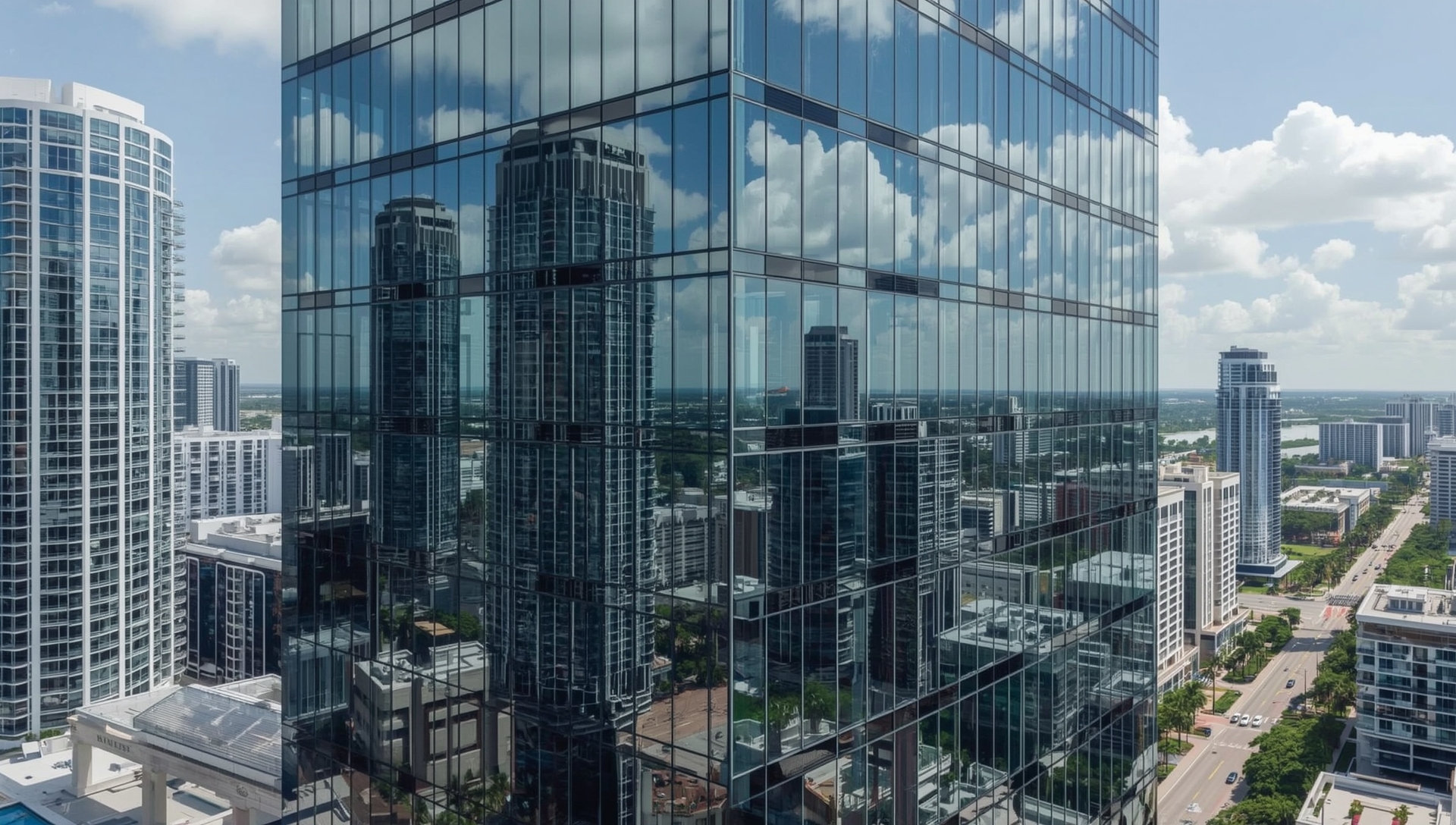
Stand at the edge of Brickell Avenue and look north toward downtown Miami on any given afternoon. The skyline that greets you is one of the most visually striking in the Western Hemisphere. Towers of glass rise fifty, sixty, seventy stories into the humid Florida sky, their facades catching the afternoon sun and throwing light in every direction. It is a skyline built on ambition, and it is changing fast.
Miami's construction boom has not slowed. New residential towers are reshaping Edgewater. Mixed-use developments are filling in the gaps along the Miami River and the Design District. Brickell continues to grow denser and taller with each passing year. And as these buildings push higher and glass becomes the dominant building material, a quiet but significant technology is being woven into their interiors: smart privacy film.
PDLC film, the technology that allows glass to switch instantly from clear to opaque on command, is finding a natural home in Miami's high-rise buildings. The reasons are practical as much as they are aesthetic. Miami's sun is intense. Its humidity is relentless. The privacy dynamics of a glass tower in a dense urban environment are unlike anything found in a suburban office park. And the expectations of tenants, residents, and hospitality guests in a world-class city like Miami have risen accordingly.
At 305 Film Masters, we install smart privacy film throughout South Florida's commercial and residential towers. We have seen firsthand how the technology is being adopted, what problems it solves, and where it is headed next. This article walks through why Miami's high-rise buildings have become one of the most compelling environments for switchable film technology in the country.
The Unique Demands of Miami High-Rise Buildings
Miami's high-rise buildings face a set of environmental and operational challenges that are genuinely distinct from those found in most other American cities. Understanding those challenges is key to understanding why smart privacy film has taken hold here as quickly as it has.
The sun exposure is extraordinary. Miami sits at a subtropical latitude, which means direct solar radiation is intense for most of the year. A glass tower on Brickell Key or in Sunny Isles Beach is absorbing far more solar energy per square foot than a comparable building in Chicago or even Atlanta. West-facing and south-facing glass surfaces in particular can become significant heat loads during the afternoon hours, driving up cooling costs and creating uncomfortable glare for occupants.
The glass footprint of modern towers compounds this challenge. Architectural trends have moved strongly toward floor-to-ceiling glazing on all four exposures. It looks spectacular from the outside and provides panoramic views from within, but it means there is very little in the way of opaque wall surface to buffer heat gain and manage privacy. Buildings are, in effect, giant glass envelopes.
Humidity is another persistent factor. Miami's climate is aggressively humid, particularly from June through October. Window treatments and blinds that might hold up reasonably well in a dry climate can degrade quickly in South Florida. Fabric blinds accumulate moisture, grow mold, and need frequent replacement. Hard surface solutions are generally more durable in Miami's environment, which is one of the reasons film-based technologies tend to perform reliably here over the long term.
Finally, the density of Miami's urban core creates privacy dynamics that simply do not exist in lower-density markets. When two fifty-story towers stand within a few hundred feet of each other, as they do throughout Brickell and downtown, the residents and workers inside those towers have direct sightlines into each other's spaces. Privacy is not an abstract concern. It is a daily reality that tenants and residents actively think about.
Commercial Applications: Offices, Boardrooms, and Amenity Spaces
Miami's commercial real estate market has experienced significant growth in recent years, driven in part by the migration of financial firms, technology companies, and professional services businesses from the Northeast and West Coast. Class A office towers throughout Brickell, Coconut Grove, and Coral Gables have had to compete aggressively for tenants who arrived from markets accustomed to sophisticated, thoughtfully designed work environments.
Smart privacy film has emerged as a meaningful differentiator in commercial office fit-outs. For conference rooms and boardrooms in particular, the technology solves a design problem that was previously handled with expensive frosted glass installations or manual blinds. A law firm on the fortieth floor of a Brickell tower can use switchable film on its conference room glass to maintain an open, luminous feel throughout the day, then create instant, complete visual privacy the moment a client meeting begins. No blinds to pull. No curtains to draw. Just a wall switch or a tap on a control panel.
Healthcare and medical office tenants, who occupy a growing share of high-rise space in Miami's urban core, have specific privacy requirements that make switchable film particularly valuable. Exam rooms, consultation spaces, and telehealth suites need on-demand privacy that also feels modern and clean. PDLC film delivers exactly that, and it can be installed on existing glass partitions without requiring construction.
Amenity spaces in Miami's office towers have also become a focus for smart film installations. Co-working areas, wellness rooms, meditation spaces, and executive lounges benefit from the ability to shift between open and private configurations as usage demands change throughout the day. Building managers appreciate the flexibility that smart film provides without requiring physical partition systems that would limit how a space can be reconfigured over time.
Common areas and lobby glass are another application gaining traction in commercial buildings. Switchable film on lobby partitions, elevator vestibule glass, and management office windows gives building operators control over transparency that was previously impossible without blocking natural light entirely.
Luxury Residential: High-End Condos Leading the Trend
Miami's luxury condominium market is among the most competitive in the world. Developments in Brickell, Miami Beach, Edgewater, and Sunny Isles Beach compete for buyers who can choose from comparable properties in New York, London, Dubai, or Singapore. Differentiating a luxury condominium in this environment requires genuine innovation, not just upgraded finishes and higher ceilings.
Smart privacy film has found a strong foothold in this segment because it delivers something that resonates immediately with high-net-worth buyers: effortless, elegant control over their environment. In a luxury residence where every detail has been considered, the ability to transform a bathroom window or a bedroom partition from transparent to opaque at the touch of a button feels genuinely premium. It is the kind of feature that shows up in a sales tour and stays in a buyer's memory.
Bathroom and en suite applications are among the most popular in Miami's luxury condo market. Many high-end developments feature master bathrooms with large windows or skylights designed to maximize light and views. Smart privacy film allows residents to enjoy those architectural features during the day while ensuring complete privacy whenever needed. The alternative, covering an expensive view with a shade or shutter, feels like a compromise. Smart film is not a compromise.
Bedroom and living room applications are also common in Brickell and Miami Beach residences. Floor-to-ceiling windows that look out over the bay or the ocean are a primary selling point for many units. Switchable film allows those windows to function as privacy walls at night or during sensitive moments without sacrificing the open, airy feel that makes the unit desirable. Motorized shades and curtains are an option, but they consume wall and ceiling space, require track systems, and introduce mechanical components that can fail. Smart film requires none of that infrastructure.
Penthouse and large-format units are seeing entire suites of smart film applications, covering bedroom partitions, bathroom walls, terrace sliding doors, and home office glass. In these installations, the film is typically integrated into the building's smart home system, allowing occupants to control every surface from a single app or voice interface.
Sun Control and Energy Savings in the Florida Climate
One of the most compelling arguments for smart privacy film in Miami's high-rise buildings goes beyond privacy. It is about energy performance. Florida's cooling load is among the highest in the country, and glass is the primary pathway through which solar heat enters a building. In a tower with floor-to-ceiling glazing on multiple exposures, managing solar gain is directly tied to the building's energy costs and its carbon footprint.
Smart privacy film, when switched to its opaque state, significantly reduces the amount of solar radiation passing through the glass. The frosted state scatters and partially blocks incoming light, reducing heat gain in a way that clear glass obviously cannot. For west-facing offices or south-facing residential units that receive direct afternoon sun for several hours daily, activating smart film during peak solar hours can measurably reduce the load on the building's HVAC system.
UV protection is a related benefit. Even in the clear state, quality PDLC film blocks a significant percentage of ultraviolet radiation. UV exposure is a major concern in Miami, not just for occupants' health but for interior finishes, furniture, flooring, and artwork. Luxury condo buyers who invest heavily in high-end interiors benefit from the UV filtration that smart film provides as a baseline function, separate from any privacy or glare-control use.
Buildings pursuing LEED certification or other green building designations increasingly look at smart film as a component of their overall energy strategy. While it is not a substitute for high-performance glazing, it is a meaningful addition to an integrated approach to solar management that also includes window orientation, shading, and building automation.
Privacy at Altitude: More Important Than You Think
A common assumption about high-rise living and working is that height provides inherent privacy. If you are on the thirty-fifth floor, who is going to see into your space? The reality in Miami's dense urban core is more complicated than that assumption suggests.
In Brickell, Edgewater, and parts of downtown Miami, towers are close enough to each other that residents on mid-level floors have clear sightlines into neighboring buildings. Two towers separated by a street or a narrow block can have dozens of floors with direct visual angles into each other's spaces. Occupants of both buildings are effectively looking into each other's homes and offices from the moment the sun goes down and interior lighting makes interiors visible from outside.
Drone activity is also an increasingly relevant concern in Miami. Commercial photography, real estate documentation, news gathering, and recreational drone flying have all increased dramatically over the past several years. Balconies, terraces, and rooms with unobstructed glass are no longer as visually secluded as they once were, even at significant height. Smart privacy film gives occupants the ability to close off visual access instantly, without blocking light or views when privacy is not needed.
For commercial tenants, privacy at altitude is a compliance and confidentiality matter. Financial firms, legal offices, and healthcare providers have regulatory obligations around visual privacy that apply regardless of what floor they occupy. Smart film provides a reliable, documented means of maintaining that privacy without restricting the open, daylit work environments that today's employees expect.
Integration With Building Automation and Smart Systems
One of the most significant factors driving smart privacy film adoption in Miami's high-rise buildings is how naturally the technology integrates with modern building automation and smart home platforms. PDLC film is controlled by a low-voltage electrical signal, which makes it straightforward to connect to virtually any control system already in a building or a residence.
In commercial buildings, smart film can be connected to the building management system and programmed to respond to schedules, occupancy sensors, daylight sensors, or manual override controls at the room level. A conference room can be set to automatically switch to opaque when an occupancy sensor detects a meeting in progress, then return to clear when the room empties. This kind of automation reduces the friction of manual control and ensures that privacy and energy management happen consistently without depending on individual occupants to remember to adjust settings.
In luxury residential units, smart film integrates seamlessly with platforms like Control4, Lutron, Crestron, and Apple HomeKit. Residents can create scenes that adjust the film alongside lighting, audio, temperature, and motorized shades in a single command. A "Good Night" scene might switch the bedroom film to opaque, dim the lights, and lower the thermostat simultaneously. A "Morning" scene reverses those settings, allowing natural light in while maintaining privacy until the resident is ready for the day.
Voice control integration through Amazon Alexa, Google Assistant, and Siri is also possible in most smart home configurations. For residents who have invested in a fully connected smart home, smart privacy film is a natural extension of that ecosystem rather than a standalone product that requires separate management.
What's Next for Miami's Smart Glass Revolution
The adoption of smart privacy film in Miami's high-rise buildings is accelerating, not plateauing. Several forces are converging to push the technology further into the mainstream of both commercial and residential construction in South Florida.
The cost of professional PDLC film installation continues to become more accessible as the market matures and competition among quality installers increases. What was once reserved for the highest-end luxury projects is now a realistic option for mid-market commercial fit-outs and moderately priced residential renovations. This democratization of the technology is expanding the market significantly.
Architectural specifications are also evolving. More Miami architects and interior designers are including smart privacy film as a standard specification on commercial and luxury residential projects rather than treating it as an optional upgrade. As familiarity with the technology grows within the design community, it is increasingly likely to appear in project documents from the earliest planning stages rather than being retrofitted after construction is complete.
Miami's continued growth as a global city, with ongoing investment in Brickell, the Miami Worldcenter mixed-use development downtown, and planned residential towers throughout Edgewater and Little Havana, means the pipeline of high-rise projects where smart film is a natural fit is substantial. The trajectory for smart privacy film in South Florida's skyline is clearly upward.
If you own, manage, or are developing a commercial or residential high-rise property in Miami and are ready to explore what smart privacy film can do for your space, the team at 305 Film Masters is here to help. We bring deep expertise in PDLC film installation across South Florida's commercial towers and luxury residential buildings. Contact us today to schedule a site consultation and receive a detailed quote. You can reach our team by phone at (305) 489-9930, by email at info@305FilmMasters.com, or through our website. We are available Monday through Friday, 9 AM to 5 PM, and we look forward to helping you take your building to the next level.