
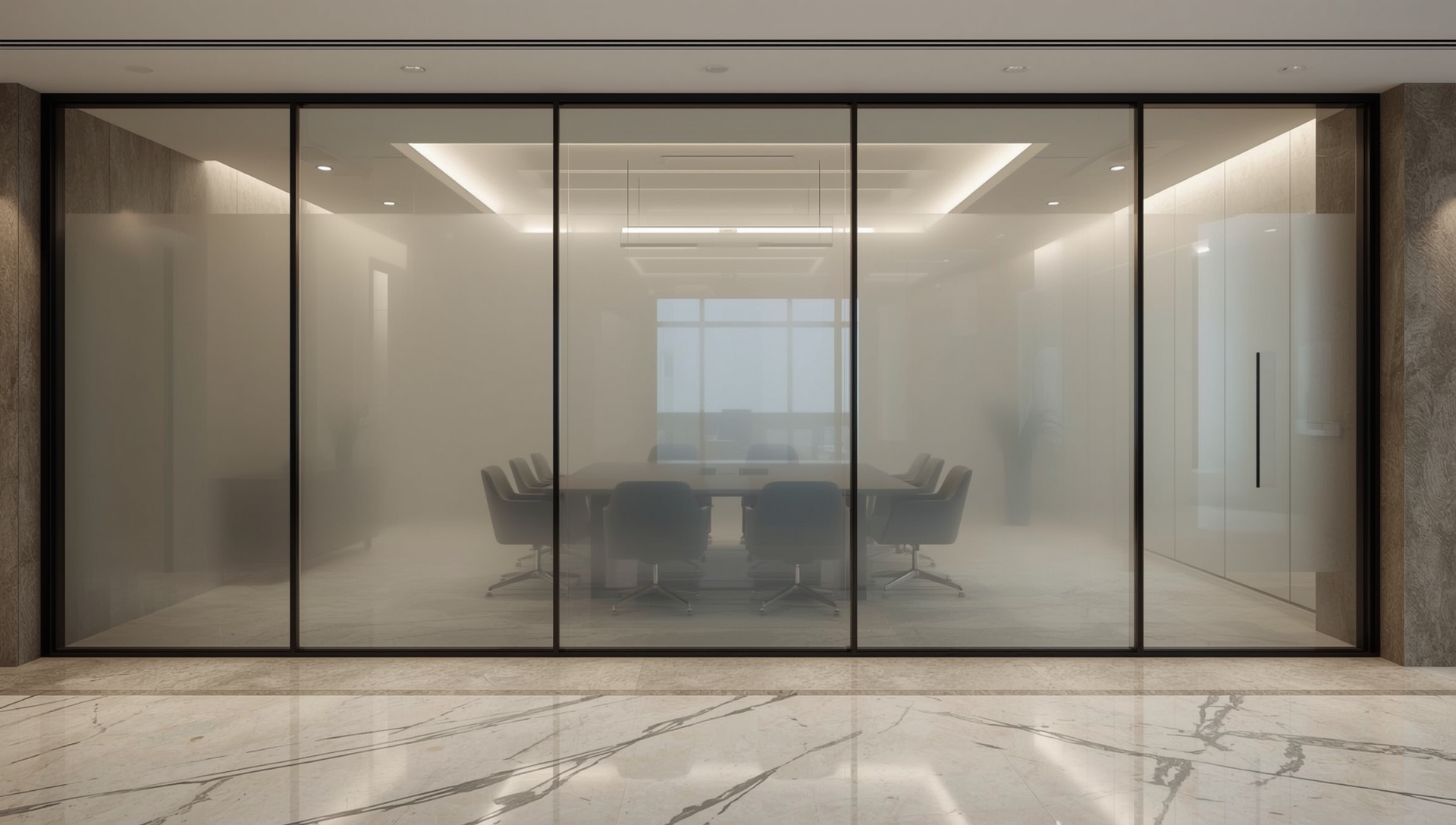
If you have walked through a modern hotel lobby, a high-end conference center, or a cutting-edge medical facility in recent years, there is a good chance you have encountered PDLC switchable film without realizing it. The glass partition that turned frosted at the press of a button, the boardroom windows that went opaque at the start of a presentation, the clinic consultation room wall that switched from clear to private in an instant: all of these are powered by the same underlying technology.
PDLC stands for Polymer Dispersed Liquid Crystal. It is the material science behind what the industry broadly refers to as smart glass, switchable film, or smart privacy film. The technology has been in commercial use for several decades, but advances in manufacturing quality, electrical efficiency, and product durability have brought it from a niche luxury item to a practical, cost-effective solution for commercial and residential applications across South Florida and beyond.
This guide covers everything you need to know about PDLC switchable film: what it is, how it works at a technical level, what types of products are available, how installations are carried out, and what performance and maintenance expectations are realistic. Whether you are an architect specifying glass for a new commercial build in Miami, a homeowner evaluating privacy options for a bathroom renovation, or a facility manager researching upgrades for an existing office, this resource will give you a thorough foundation.
What Is PDLC Technology?
Polymer Dispersed Liquid Crystal technology is a class of electro-optic material that changes its optical properties in response to an electrical field. The core component is a thin film containing microscopic liquid crystal droplets suspended within a polymer matrix. This film is sandwiched between two layers of transparent conductive material, typically indium tin oxide (ITO), and sealed between protective layers of polyester or glass.
Liquid crystals are materials that exhibit properties of both liquids and solid crystals. They flow like liquids but maintain a degree of structural order similar to crystalline solids. Crucially for this application, liquid crystals respond to electrical fields by aligning their molecular orientation. In PDLC film, each microscopic droplet of liquid crystal acts as an independent optical switch.
The polymer matrix holds the liquid crystal droplets in place while allowing them to respond to the applied electrical field. The transparent conductive layers on either side of the film carry the electrical current that generates the field. The protective outer layers provide mechanical durability, UV resistance, and the adhesive surface needed for glass application.
The result is a thin, flexible laminate that can be applied to existing glass surfaces or incorporated into fabricated glass panels during manufacturing. When electricity flows through the conductive layers, the liquid crystals align and the film becomes transparent. When power is cut, the liquid crystals return to a random orientation and the film scatters incoming light, appearing frosted or opaque.
How PDLC Film Works: The Science Explained
Understanding the switching mechanism in detail helps clarify both the capabilities and the practical limitations of the technology.
The Off State: Frosted and Private
When no electrical current is applied, the liquid crystal droplets within the polymer matrix are randomly oriented. Each droplet scatters light differently from its neighbors because the optical axis of each droplet points in a different direction. When light enters the film, it encounters these randomly oriented droplets and scatters in multiple directions rather than passing through in a straight path.
This scattering effect is what produces the frosted, translucent appearance that the film is known for in its default, unpowered state. The film is not opaque in the sense that it blocks all light. Rather, it diffuses light in the same way that etched or sandblasted glass does, allowing illumination to pass through while preventing the transmission of a clear image. People and objects on the other side of the glass are not visible as distinct forms, though light and general color can still be perceived.
This characteristic is actually a significant practical advantage. In the off state, smart privacy film still allows daylight to enter a space. A bathroom with switchable film on the shower enclosure remains bright and airy even when the film is in its private, frosted state. This distinguishes it clearly from a blackout blind or a solid wall.
The On State: Clear and Transparent
When alternating current is applied to the conductive layers, an electrical field is generated across the film. This field exerts a torque on the liquid crystal molecules within each droplet, causing them to align parallel to the direction of the field. When all of the liquid crystal droplets are aligned in the same direction, their optical axes are parallel and light passes through the film with minimal scattering.
The film transitions from its frosted state to clear transparency within milliseconds. The switch is instantaneous from the human perspective, with no perceptible lag. The clear state allows the glass to function essentially as standard transparent glass, with only a very slight reduction in visible light transmission compared to uncoated glass.
It is important to note that the film requires power to remain in its transparent state. This is an inherent property of the technology and has practical implications for wiring design and power planning, particularly in applications where a power outage or system failure would make the default frosted state either desirable or problematic.
Types of PDLC Products
The PDLC market offers two primary product categories, each suited to different project types and budget considerations.
Self-adhesive retrofit film. This is the more common product for both residential and commercial installations involving existing glass. The PDLC laminate is manufactured with a pressure-sensitive adhesive on one side, allowing it to be applied directly to the surface of installed glass panels, windows, partitions, or doors. Retrofit film is cost-effective, minimally disruptive to install, and can be applied to glass that is already in place without requiring any structural modifications or glass replacement. This makes it the preferred choice for renovation projects, tenant improvement work, and residential upgrades. The installed result is indistinguishable from factory-laminated smart glass to casual observation.
Pre-laminated smart glass panels. In this format, the PDLC film is integrated into a glass panel during the manufacturing process, typically as an interlayer within a laminated glass unit. The film is sealed between two layers of glass using a lamination process similar to that used for safety glass. Pre-laminated smart glass offers superior edge sealing, a more permanent installation, and the structural properties of laminated safety glass. It is the preferred specification for new construction, high-traffic applications, and projects where building codes require rated glazing assemblies. The cost per square foot is higher than retrofit film, and glass panels must be ordered and fabricated in advance to the required dimensions.
Both product types are available from reputable manufacturers in a range of film specifications that affect switching voltage, clarity in the on state, and haze level in the off state. Selecting the right specification for a given application is part of the value an experienced installer brings to a project.
Power and Control Requirements
PDLC film operates on low-voltage alternating current, typically in the range of 48 to 65 volts AC at a frequency of 50 to 60 Hz. The current draw is very low, measured in milliamps per square foot, which means that power consumption is minimal even for large installations. A 100-square-foot installation running continuously would consume a small fraction of a kilowatt-hour per day.
Because standard household and commercial electrical systems operate at much higher voltages (120V or 240V in the United States), a transformer or driver unit is required to step down the voltage to the appropriate level for the film. These driver units are compact and can be installed in a junction box, cabinet, or concealed location near the glass installation.
Control of the film can be implemented through several methods. A simple on/off wall switch wired to the driver is the most straightforward approach and is entirely adequate for most residential applications. Remote controls and touch switches are popular alternatives that eliminate the need for a wired switch location. Dimmer-style controllers can be used with some film specifications to set the film to a partially switched state, offering an intermediate level of translucency between fully frosted and fully clear.
For commercial and smart home applications, PDLC film integrates readily with building automation systems and home automation platforms. Control4, Crestron, Lutron, and similar platforms can send switching signals to compatible PDLC drivers, allowing the glass to be controlled via touchpanel, voice command, scheduling, occupancy sensor, or any other trigger the automation system supports. This level of integration is a significant advantage in conference room, hospitality, and high-end residential applications across Miami's commercial and luxury real estate markets.
Installation Process Overview
A professional PDLC film installation follows a structured process that prioritizes surface preparation, precise application, and reliable electrical connection. Each phase contributes to the long-term performance and appearance of the finished installation.
Site assessment and measurement. Before any material is ordered or cut, the installer evaluates the glass surfaces to be treated. This includes verifying the glass type (tempered, laminated, insulated, tinted), measuring the exact dimensions of each panel, assessing the condition of the glass surface, identifying any coatings or films already present, and planning the routing of electrical connections to switch and driver locations. Accurate measurement is critical because PDLC film must be cut precisely to fit each panel with clean edges.
Glass surface preparation. Thorough cleaning of the glass is essential for proper adhesion and optical clarity. Professional installers use a sequence of cleaning agents and techniques to remove all contamination from the glass surface, including dust, grease, fingerprints, hard water deposits, adhesive residue from previous films, and any other material that could affect the bond between the film and the glass. In South Florida's coastal environment, salt deposits and humidity-related contamination require particular attention.
Film cutting and application. The PDLC film is cut to the measured dimensions using precision cutting tools. The film is applied to the glass using a wet application technique, in which a slip solution is applied to the glass surface to allow the film to be positioned and adjusted before the adhesive sets. Air bubbles and wrinkles are worked out using application squeegees, and the film is trimmed precisely at the edges to match the glass panel dimensions.
Electrical connection. The bus bars at the edges of the film, which carry the electrical current to the conductive layers, are connected to the output leads of the driver unit using appropriate connectors and wiring. The driver is connected to the control switch or automation system interface. All connections are tested to confirm proper switching operation before the project is closed out.
Curing period. After installation, the film requires a curing period during which residual moisture from the application process evaporates through the film. Some minor haziness during this period is normal and expected. Most installations reach their final optical clarity within 2 to 4 weeks, depending on ambient temperature and humidity conditions.
Performance Specs: Switching Time, Clarity, UV, Lifespan
Understanding the performance characteristics of PDLC film helps set realistic expectations and supports accurate specification for particular applications.
Switching speed. The transition from frosted to clear and back occurs within 10 to 100 milliseconds under normal operating conditions. This is effectively instantaneous to human perception. The exact switching time varies slightly with film specification and operating temperature, with warmer temperatures generally producing faster switching.
Visible light transmission. In the clear (on) state, quality PDLC film typically transmits 70 to 85 percent of visible light, compared to approximately 90 percent for uncoated clear glass. This slight reduction is not perceptible in most applications. In the frosted (off) state, the film transmits 50 to 65 percent of incident light in a diffused form, keeping spaces bright while obscuring the view through the glass.
Haze level in the frosted state. Haze, measured as the percentage of transmitted light that is scattered more than 2.5 degrees from the incident beam, is the metric that describes how effectively the film obscures the view in its opaque state. Quality PDLC film products achieve haze values of 95 percent or higher in the off state, which is sufficient to prevent the recognition of faces or objects on the other side of the glass at normal viewing distances.
UV rejection. Most PDLC film products incorporate UV-absorbing layers that block 99 percent or more of ultraviolet radiation in both the clear and frosted states. This is a meaningful benefit for Miami homeowners and commercial property owners, where intense UV exposure can fade furnishings, artwork, and flooring materials.
Operating lifespan. Quality PDLC films are rated for 100,000 hours or more of powered operation under normal conditions. Given that most installations cycle the film on and off rather than running it continuously, practical lifespans of 10 to 15 years are typical and well-documented. The film does not degrade mechanically from switching cycles, and the liquid crystal material itself is stable under normal operating conditions.
Maintenance and Care
One of the underappreciated advantages of smart privacy film is the simplicity of its maintenance requirements. There are no moving parts to lubricate, no mechanical components to inspect, and no fabric surfaces to clean, treat, or replace.
Routine cleaning of the glass surface follows the same guidelines as standard glass care. Use a soft, lint-free cloth or microfiber towel with a mild, non-abrasive glass cleaner. Avoid cleaners containing ammonia, abrasive compounds, or strong solvents, as these can degrade the film surface or edge sealing over time. Do not use razor blades or abrasive scrub pads on the film surface.
The edges of the film, where the bus bar connections are made, should not be exposed to prolonged water immersion or moisture intrusion. For bathroom installations, ensure that shower surrounds and caulk lines are properly maintained to prevent water from reaching the film edges. In South Florida's humid environment, this is a routine part of bathroom upkeep regardless of whether smart film is installed.
If a section of film develops a persistent defect or the electrical connection fails at any point, a qualified installer can assess whether a repair or partial replacement is feasible. In many cases, localized issues can be addressed without replacing the entire installation.
Common Applications
PDLC switchable film is in active use across a wide range of commercial and residential applications throughout Miami and South Florida.
- Conference rooms and boardrooms: Switchable glass partitions offer instant privacy for meetings without the need for permanent walls or bulky window treatments.
- Healthcare facilities: Patient rooms, consultation areas, and procedure rooms benefit from hygienic, easily cleaned switchable glass that provides privacy on demand.
- Hospitality: Hotels use smart film in suite bathrooms, lobby partitions, and restaurant dividers to deliver premium guest experiences.
- Retail and showrooms: Switchable display windows can be cleared for product visibility during business hours and made private after closing.
- Residential bathrooms and bedrooms: Miami homeowners upgrade glass shower enclosures, bedroom windows, and glass partitions with smart film for privacy without sacrificing natural light.
- Home offices and study areas: On-demand frosting improves focus and professionalism during video calls without requiring physical blinds or curtains.
- Legal and financial offices: Compliance with client confidentiality requirements is easier to manage when private areas can be visually secured instantly.
Why PDLC Is the Future of Glass
The built environment is evolving rapidly toward greater flexibility, technology integration, and occupant control. Fixed architectural elements, including walls and permanent glass treatments, are giving way to adaptable, programmable surfaces that serve multiple functions depending on the needs of the moment. PDLC switchable film is one of the clearest expressions of this trend.
As manufacturing costs continue to decline and integration with smart building and home automation platforms becomes increasingly seamless, the barrier to adoption is dropping. Architects are specifying smart glass earlier in the design process. Developers are including it in premium residential and commercial offerings as a standard feature rather than an upgrade. Homeowners in Miami's competitive real estate market are recognizing it as both a lifestyle improvement and a property value driver.
The technology is proven, the products are mature, and the installation expertise is available today. PDLC switchable film is not a product that requires waiting for future improvements. It is a ready solution for anyone who wants the flexibility to control their environment, protect their privacy, and maintain the open, light-filled spaces that define modern architecture.
If you are ready to explore PDLC switchable film for your Miami home or commercial space, the specialists at 305 Film Masters are here to guide you from product selection through professional installation. We have the experience and technical knowledge to design and execute a smart film installation that meets your specific privacy, aesthetic, and automation requirements. Contact 305 Film Masters today to schedule your consultation and get a detailed quote for your project.